In commercial properties perception begins long before someone steps inside. The exterior of a building sets an expectation, and the windows are often one of the first details people notice, even if only subconsciously. A clean, well-maintained facade creates a sense of order and reliability, while neglected glass can quietly suggest the opposite.
This is where office window cleaning becomes part of the broader business environment. In NYC commercial buildings compete for attention on every block and the condition of the windows contributes directly to how the entire property is perceived. It affects how clients view the company inside, how tenants feel about their space, and how the building fits into its surroundings. From a property management perspective, this also ties into value. A building that is visually maintained signals ongoing care, which can influence long-term occupancy decisions.
Understanding this connection helps shift the conversation from cleaning as a routine service to cleaning as part of maintaining business presence and visual consistency. That is where the real value of office window cleaning in NYC begins to take shape, especially when the goal is to support image and long-term property performance.
When clean glass starts shaping the business
The effect of the exterior does not stop at appearance. Once a building looks cared for, that impression starts to influence how people read the business inside it. Commercial spaces in a city like New York are judged quickly and often visually, the condition of the windows becomes part of the message the building sends every day.
Professionalism people can see
A clean office facade suggests that the property is maintained with intention and that the business inside pays attention to details that customers and partners are likely to notice. That is essential, because professionalism is rarely communicated through a single gesture. It is usually built through repeated signals, and the state of the windows is one of the first of those signals. When glass is clear and even, the building feels more structured and more reliable. When it is dull, streaked, or marked by buildup, the visual message changes. Even if the interior is well run, the exterior can create a weaker first read, and that can influence how the business is perceived before a conversation begins.
Tenant satisfaction in multi-tenant buildings
In buildings with multiple tenants, the effect is even broader. The condition of the windows does not reflect only one company, as it shapes the shared environment that everyone inside experiences. Clean exterior glass can make the building feel brighter, better maintained, and more comfortable for people who work there every day. Tenants notice when a property is consistently cared for, and that can influence how they feel about the building overall. It affects natural light, the view from workspaces, and the general sense of order in the environment.
Property managers often have to balance appearance, practicality, and long-term value. Window cleaning supports all three. It helps the building look current, keeps the environment more pleasant for occupants, and reinforces the idea that the property is being actively maintained rather than left to weather on its own.

How the workspace feels inside the building
The influence of clean windows continues into the interior environment, where people spend most of their working hours. In office settings, especially in dense urban areas like NYC, light, visibility, and the overall feeling of the space are closely connected to how the exterior glass is maintained.
Psychological effect of a brighter workspace
There is also a psychological component to how people respond to light and clarity. Bright, well-lit environments are often associated with more positive moods and a greater sense of energy during the workday. This does not come from the windows alone, but they play a role in how that environment is created. When the exterior glass is maintained, the interior feels more connected to the outside world. This can reduce the sense of confinement that sometimes develops in large office buildings, especially in areas with limited direct views or dense surroundings.
Productivity as a byproduct of environment quality
Productivity in office settings is shaped by many factors, and the physical environment is one of them. Clean windows support that environment by improving light quality, reinforcing visual clarity, and contributing to a more comfortable workspace. The effect of it builds gradually through daily experience. Better environmental conditions support better focus and steadier performance across teams, which is why window maintenance becomes part of operational consistency.
What determines the right cleaning frequency for offices
The question is usually not whether windows should be cleaned, but how often the schedule should run. The answer depends on the building’s exposure, how much foot traffic it gets, and how much visibility the glass has from the street. Top Team’s commercial guidance places many office properties in a regular 1 to 3 month cycle, while high-traffic properties may need cleaning every 2 to 4 weeks. Frequency also shifts when weather, pollution, or building conditions create faster buildup.
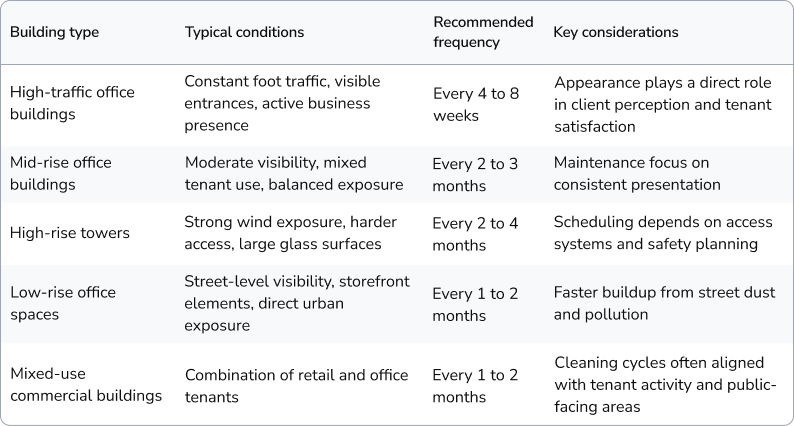
Seasonal timing matters as much as building type. Heavy rain, winter storms, prolonged humidity, and periods of stronger outdoor debris can all affect how quickly glass loses its clarity, which means the same office may need a lighter schedule in one season and a tighter one in another. For facility teams, the useful approach is to treat frequency as a flexible plan that follows the building’s real conditions instead of a fixed calendar rule.
Keeping the building running while the work gets done
Scheduling is one of the most sensitive parts of commercial window cleaning for many property managers. The quality of the result is important, but so does the way the work fits into the daily life of the building. Offices continue operating, tenants continue working, and visitors continue moving through the space, which means the cleaning process has to support all these processes.
- After-hours cleaning helps reduce interruptions
In busy office environments exterior and interior work is often scheduled outside standard business hours. Early mornings, evenings, or overnight service windows allow crews to work more efficiently while employees and visitors are no longer moving through high traffic areas. This also helps reduce distractions inside offices where meetings, phone calls, and client interactions are happening throughout the day.
- Weekend scheduling creates more flexibility for larger projects
Some commercial buildings require a broader cleaning scope that is difficult to complete during active workdays. Weekend scheduling gives crews more room to manage access points, equipment positioning, and larger facade sections without competing with weekday building activity.
- Building access requires coordination
Commercial window cleaning in NYC often depends on access approvals, elevator coordination, rooftop entry, and communication with building management teams. The larger the property, the more important that coordination becomes. Careful planning helps crews move through the building efficiently while reducing delays and avoiding unnecessary interruptions to normal operations.
- Street activity changes how exterior work is planned
Office buildings rarely exist in quiet surroundings. Sidewalk traffic, delivery schedules, nearby construction, and loading zones all influence when exterior work can happen safely and practically. Scheduling has to account for those conditions so the work remains controlled even in dense commercial areas.
The method changes with the building

By the time scheduling, access, and operational concerns are addressed, the next question becomes practical. How does the work actually get done on different types of office buildings in NYC? The answer depends on the structure itself, because commercial window cleaning methods are chosen according to height, facade design, surrounding space, and access conditions.
- Rope access for tall and complex facades
Rope access is commonly used on high rise buildings where traditional equipment cannot move efficiently across the exterior. This method allows trained technicians to work directly along the facade while maintaining controlled movement and precise positioning. It is especially useful on buildings with narrow access zones or architectural layouts that limit heavier equipment.
- Aerial lifts for controlled exterior access
Some office buildings benefit from mobile access systems that can reach large glass sections while remaining stable at ground level. Aerial lifts are often used where the surrounding area allows equipment positioning and where the facade can be accessed efficiently from below. This method works well on commercial buildings that require flexibility across different heights without relying on permanent rooftop systems.
- Scissor lifts for lower and mid-rise properties
Interior atriums, lower commercial structures, and certain multi-level spaces often call for compact vertical access. Scissor lifts help crews work steadily in these environments while maintaining controlled movement inside tighter areas. This method is frequently chosen when the workspace itself limits larger equipment.
- Scaffolding and BMU systems for large-scale buildings
Some commercial facades are designed around permanent or semi permanent building maintenance systems. In those cases scaffolding and BMU access allow cleaning teams to move across wide exterior surfaces with consistency. This approach is often associated with large office towers and buildings that require structured long-term maintenance planning.
- Water fed pole systems for efficient lower-level cleaning
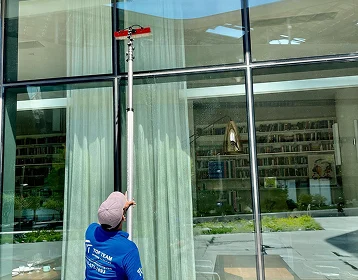
Water fed pole systems are frequently used for lower sections of commercial buildings and areas that can be safely reached from the ground. Purified water helps reduce residue and allows the glass to dry clearly without additional contact, which makes this method efficient for routine maintenance work.
Exterior glass faces weather, pollution, and environmental buildup, while interior glass is affected more by fingerprints, dust, and everyday office activity. Because of that, the cleaning process changes depending on which side of the building is being serviced. Exterior work focuses heavily on access and environmental conditions, while interior cleaning usually depends on timing, tenant coordination, and minimizing disruption inside active office spaces.
The method itself becomes part of the strategy: a building with complex architecture may require rope access, while another property may benefit from lifts or ground based systems that allow faster recurring maintenance. Choosing the right approach helps keep the work safer, more efficient, and better suited to the actual conditions of the property.
Top Team works with office buildings and commercial properties across NYC using methods that match the structure, access conditions, and operational needs of each project. Request a consultation to discuss your building, scheduling needs, and the most practical approach for your property.