The surfaces of a city in crisis?
The change started on the trains. In the early 1970s, paint appeared gradually on New York City's subway cars. Names came first, single-color signatures in block letters crossing steel panels above windows, below doors, across end-caps of each car. By the middle of the decade, signatures had grown into full compositions: floor-to-ceiling murals in silver, gold, and color, wrapping entire car exteriors.
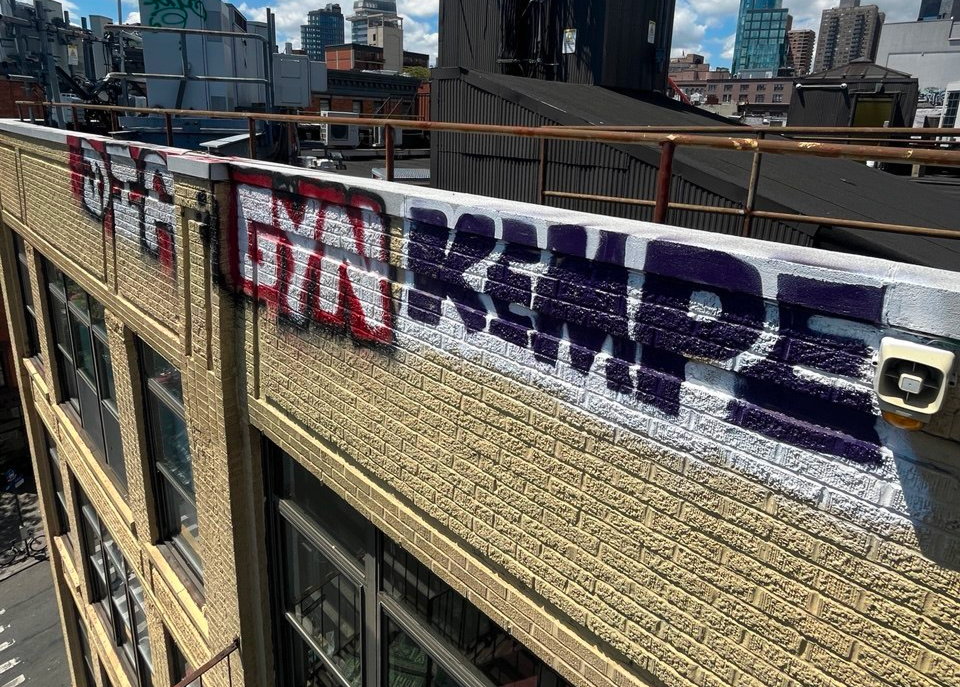
The condition spread from the subway outward onto the surfaces of the city itself. Walls, storefronts, highway underpasses, water towers, building facades, and exterior trim on residential blocks throughout the five boroughs were affected. The materials were aerosol paint and broad-tipped permanent markers portable, inexpensive, and capable of leaving marks that could last years on untreated masonry and concrete without fading.
What began as a localized form of name-marking became, within a few years, a systemic condition affecting nearly every exterior surface category the city maintained. Understanding how that condition formed, and how New York developed the methods to reverse it gives practical grounding to the graffiti removal and surface protection work that defines responsible urban building management today.

The subway fleet as ground zero
By the mid-1970s, the Metropolitan Transit Authority operated several thousand subway cars, and a large portion of them carried paint on their exteriors. The compositions ranged from simple tags, a artist's name, random words, and political statements in a single color to elaborate full-car murals covering multiple panels in layered pigments requiring hours of application.
The MTA's annual expenditure on graffiti removal reached tens of millions of dollars by the early 1980s, for an agency already operating in fiscal distress. New York City had faced a severe financial crisis in the mid-1970s, and the graffiti-covered subway became a visible indicator of the maintenance pressure bearing down on the institution responsible for it.
Several structural factors made the subway particularly vulnerable as a target:
- Overnight storage yards, known as lay-up spots, left cars unsupervised for extended periods
- Low lighting in yards and tunnels reduced the practical risk of being caught
- The scale of the system exceeded the enforcement capacity available at the time
- A single person equipped with aerosol paint could cover a full car exterior in a relatively short time
The same conditions existed, in modified form, across the built environment above ground. In the South Bronx, East Harlem, and parts of Brooklyn, neighborhoods already managing housing abandonment and disinvestment, the painted surfaces compounded the visual evidence of neglect that already marked those blocks.

Three phases of municipal response
The city's attempts to address the problem followed a progression, each phase building on the limitations of the one before it.
Phase 1: Chemical removal (late 1970s)
The MTA's earliest systematic response centered on chemical paint strippers applied across the fleet at maintenance facilities. The chemicals required constant reapplication artists returned to cleaned cars within days. Removal without a deterrence mechanism in place produced little net change in the overall condition of the fleet.
Phase 2: The Clean train movement (1984–1989)
In 1984, the MTA restructured its response around a single operational principle: no graffiti-marked car would return to service until it was fully cleaned. The logic was not primarily logistical, it was about removing the audience. Artists painted subway cars because the cars moved through the city, displaying the work to anyone on the platform or street level. A car cleaned before it left the yard was, in effect, a car that had never been painted.
The policy required parallel operational changes: lay-up yards were fenced and lit, security patrols were added, and any tagged car in active service was pulled from rotation. The deterrent effect accumulated over time. By 1989, the MTA had substantially reduced the number of graffiti-covered cars operating on the system a significant operational and institutional achievement for an agency that had been managing the condition for nearly two decades.
Phase 3: Zero tolerance and code enforcement (1990s)
The Giuliani administration in the 1990s applied the "broken windows" policing framework, developed by criminologists James Q. Wilson and George Kelling to street-level graffiti across the five boroughs. The framework held that visible surface disorder communicated a tolerance for more serious violations, and that maintaining surfaces signaled the opposite.
In practice, the policy produced several structural changes:
- Graffiti was reclassified as a prosecutable offense rather than a quality-of-life citation
- The NYPD formed dedicated anti-graffiti units targeting high-volume artists
- Sale of aerosol paint and wide-tipped markers to minors was restricted by law
- Property owners received mandatory removal timelines, with fines for non-compliance
The combination of enforcement, economic recovery, and demographic change in many affected neighborhoods produced measurable reductions in street-level graffiti through the late 1990s and into the 2000s.
The cultural residue that stayed
Municipal policy moved in one direction; the cultural influence of the writing movement moved in another, and the two trajectories did not converge.
By the mid-1980s, the art market had begun absorbing work from artists who had come up through the street era. Jean-Michel Basquiat, who had worked under the name SAMO across lower Manhattan, was selling canvases to established collectors. Keith Haring's drawings, begun in empty advertising panels inside the subway system, were circulating internationally. Hip-hop carried the visual vocabulary of spray paint into music, film, fashion, and advertising, distributing the aesthetic of New York's writing culture across markets that had never seen the original conditions that produced it.
The tension between unsanctioned tagging and institutionally recognized mural work has not resolved. The Bushwick Collective in Brooklyn maintains an open-air district of legal murals across several blocks. Unauthorized tagging in gentrifying neighborhoods continues at the street level, and the costs of removal continue to fall on building owners and property managers, a recurring line item that surfaces-focused contractors address with increasing frequency.

Modern graffiti removal: methods and materials
The technical approach to graffiti removal has changed substantially over the past two decades. Professional contractors now bring surface-specific methods to each job, selecting equipment and chemistry based on substrate, coating type, and the age of the paint. Variables that, when misread, can cause surface damage that costs more to repair than the original graffiti removal.
Pressure washing: conditions and calibration
Commercial pressure washing equipment used in graffiti removal operates across a wide range of pressure settings, with hot-water units reaching high temperatures. The combination of heat and pressure lifts aerosol and latex paint from masonry, concrete, and metal without abrasive contact, an important distinction from the solvent methods that preceded it.
The substrate determines the approach before any equipment is activated. A pre-war brick facade and a contemporary poured-concrete panel respond differently to the same pressure setting and moisture level. Professional contractors conduct a substrate assessment first, then calibrate pressure, temperature, nozzle angle, and dwell time based on surface condition.
The chemistry applied alongside pressure washing addresses different paint categories through different mechanisms:
- Alkaline cleaners address latex and water-based paints through pH disruption
- Solvent-based removers target oil-based enamels and industrial coatings by dissolving binders
- Enzymatic cleaners break down organic paint compounds at a molecular level, carrying lower environmental impact than solvent alternatives
- Poultice systems, used on porous limestone and sandstone, draw pigment out of the substrate rather than forcing solvents deeper into it
Environmental compliance in New York City requires that wastewater generated during graffiti removal not enter storm drains. Licensed contractors operate with containment barriers, wet vacuums, and filtration systems on every exterior job. The regulatory requirement distinguishes professional-grade work from lower-cost alternatives that skip containment.
For building owners thinking through the cost of pressure washing in New York, substrate type, paint age, and surface area all affect the final scope. A detailed breakdown of power washing costs for New York properties covers those variables in full.

Rope access and aerial lift methods for upper facades
Graffiti placed at height on parapets, upper facade panels, and roofline sections accessible from fire escape landings or adjacent structures requires a different access strategy than ground-level removal.
Rope access cleaning allows technicians to reach upper-facade surfaces without scaffolding, using industrial rope systems rated for exterior building work. The method is particularly useful on narrow Manhattan and Brooklyn blocks where sidewalk scaffolding would obstruct pedestrian flow or require DOT permits.
For buildings where rope access is not practical, aerial lifts and scissor lifts position technicians at working height alongside the facade. The equipment selection depends on building setback, street width, surface height, and the proximity of overhead utilities.
Soda blasting and dry ice blasting
Pressure washing at standard settings is too aggressive for historically sensitive surfaces brownstone facades, terra cotta detailing, and ornamental stonework. Two media-blasting methods address these conditions without mechanical abrasion.
Soda blasting propels sodium bicarbonate at controlled pressure against the coated surface. The blast media is softer than the stone or masonry substrate, so it removes the paint layer without etching or abrading beneath it. The residue dissolves in water and requires no specialized disposal handling.
Dry ice blasting uses CO₂ pellets accelerated to high velocity. On contact, the pellets sublimate, converting directly from solid to gas, and the rapid phase change creates a localized pressure differential that lifts the paint without leaving residual blast media on the surface. The method suits detailed ornamental work on New York's older buildings, where the geometry of the surface makes any abrasive contact problematic.
Anti-graffiti coatings: the economic shift
The broader shift in how the industry approaches recurring graffiti came with the adoption of anti-graffiti protective coatings. Applied to masonry, concrete, metal, and stone before any vandalism occurs, these coatings change the removal economics on every subsequent event.
Sacrificial coatings are wax- or resin-based films applied to the surface. When the coated surface is tagged, the paint adheres to the coating layer rather than the substrate. Removal strips the coating and the graffiti together; reapplication restores the protection. Per-event cleaning costs drop significantly compared to removing paint from unprotected masonry.
Permanent penetrating sealers, typically silane- or siloxane-based, fill the microscopic pore structure of the substrate rather than forming a surface film. Paint applied over a penetrating sealer cannot achieve bond strength and can be removed with low-pressure hot water alone. These coatings require reapplication on a multi-year cycle and are increasingly specified for ground-floor facades in high-density urban locations.
Glass vandalism and the case for protective film
Paint on masonry is expensive to remove. Scratched or etched glass is a different category of problem because scratched glass cannot be cleaned, it must be replaced or polished if applying.
Etching vandalism, where marks are scored permanently into glass using abrasive tools, became increasingly common as the cleaning efficiency for painted surfaces improved. The marks left in glass by etching tools are mechanical damage to the material itself, not surface deposits that chemistry or pressure can address. The only resolution is glass replacement, and in a city where storefront panels, lobby vestibules, elevator cabs, and commercial building windows represent a large installed asset base, the cumulative replacement cost is substantial.
Commercial storefront panels can run several thousand dollars per panel to replace, depending on glass specification, frame type, and installation access. Across a building portfolio, the exposure compounds with each event.
Anti-graffiti window film
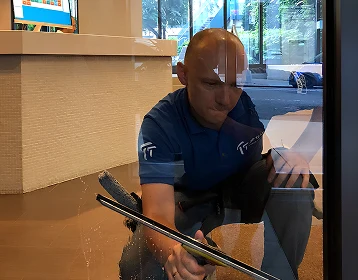
Anti-graffiti window film a polyester or polycarbonate laminate installed against the interior or exterior glass surface addresses this condition by repositioning what gets damaged. When an etching tool contacts the filmed glass, the mechanical damage occurs to the film layer. The film is stripped and replaced at a fraction of the cost of glass replacement, leaving the glass beneath undamaged.
The economics of that substitution become clearer with each vandalism event the protected surface survives. In high-exposure locations, the film installation cost typically recovers within the first or second incident it prevents from becoming a full glass replacement.
The films carry functional properties beyond graffiti protection:
- UV rejection, reducing solar heat gain and protecting interior furnishings from fading
- Fragment retention on impact, keeping broken glass from dispersing when a panel fails
- Forced-entry delay on security-specification films, extending the response window for alarm-monitored installations
- Near-zero optical distortion on premium products when professionally installed
Commercial building window cleaning in New York frequently involves assessment of existing glass condition, whether prior etching damage is present, whether film is already installed, and whether the current glazing is a candidate for protective specification. Both surfaces interact: a clean, filmed glass panel is substantially easier to maintain than an unprotected, previously scratched one.
For building owners and managers in Manhattan and Brooklyn, film specification has moved from an optional add-on to a standard inclusion in ground-floor renovation scopes, particularly for retail tenants, lobby enclosures, and elevator interiors where etching exposure is highest. Window cleaning in Brooklyn and window cleaning in Manhattan both encounter this condition with regularity across the building stock in each borough.
Liquid coatings for non-flat glass
Patterned glazing, frosted panels, mirror finishes, and decorative glass surfaces that are not optically flat do not accept film lamination cleanly. Liquid anti-graffiti coatings applied to these surfaces cure to a hard, low-surface-energy finish that prevents paint and marker adhesion. Cleaning removes the contamination without solvents that would damage the glass beneath.
Where surface protection is heading
The graffiti removal and surface protection industry in New York City operates with tools and methods that were not commercially available two decades ago, and the pace of development has not slowed. Several directions are moving from testing toward standard commercial deployment.
Penetrating sealers with longer reapplication cycles are increasingly specified for high-traffic commercial facades, reducing the per-year maintenance cost on surfaces that previously required seasonal treatment.
Rapid-response service agreements, in which building owners and property managers pre-negotiate cleaning contracts guaranteeing removal within a defined timeframe of a graffiti event, have become a recognized deterrence mechanism. The visibility of a tag its duration on the surface is a primary factor in whether a given location attracts repeat incidents. Systematic rapid removal reduces that window substantially.
The integration of visual monitoring and maintenance dispatch is also advancing. Systems capable of detecting surface changes and triggering contractor notifications are in use across several property management portfolios in New York, compressing the time between event and response in ways that manual inspection schedules cannot match.
New York City began confronting this surface condition in the early 1970s with almost no framework for addressing it at scale. What it developed over five decades through enforcement policy, contractor expertise, coating chemistry, and protective film technology is now the baseline for professional urban surface management in dense cities. The methods did not emerge from a single plan. They accumulated from the specific requirements of surfaces, materials, and conditions that kept demanding more precise answers.
Surfaces that need assessment or protection?
The materials on a given building, the age of the masonry, the type of glass, the history of prior treatments determine which removal and protection methods apply. Contact Top Team Window Cleaning to discuss the specific conditions on your property.
Sources and references:
- Metropolitan Transit Authority (MTA). Annual Reports and Capital Program Documentation, 1975–1990. New York, NY.
- Wilson, J.Q., & Kelling, G.L. (1982). "Broken windows: the police and neighborhood safety." The Atlantic Monthly, March 1982.
- New York City Administrative Code §10-117: Defacement of property. New York City Council.
- International Window Film Association (IWFA). Anti-Graffiti Film Standards and Installation Guidelines. Martinsville, VA: IWFA.
- U.S. Environmental Protection Agency. Stormwater Management for Industrial Activities: Developing Pollution Prevention Plans and Best Management Practices. EPA 832-R-92-006. Washington, D.C.: EPA, 1992.
- New York City Department of Environmental Protection. Stormwater Pollution Prevention: Contractor Requirements. New York, NY: NYC DEP.
- New York City Landmarks Preservation Commission. Cleaning and Waterproofing Masonry Buildings: Technical Report. New York, NY: LPC.
Disclaimer: This article is provided for general informational and historical purposes only. Surface conditions, material specifications, cleaning methods, and applicable regulations vary by building, substrate type, and location. Nothing in this article constitutes professional engineering, architectural, or contracting advice. Building owners and property managers should consult qualified contractors and, where applicable, the New York City Landmarks Preservation Commission or other relevant authorities before undertaking any graffiti removal or surface treatment work.